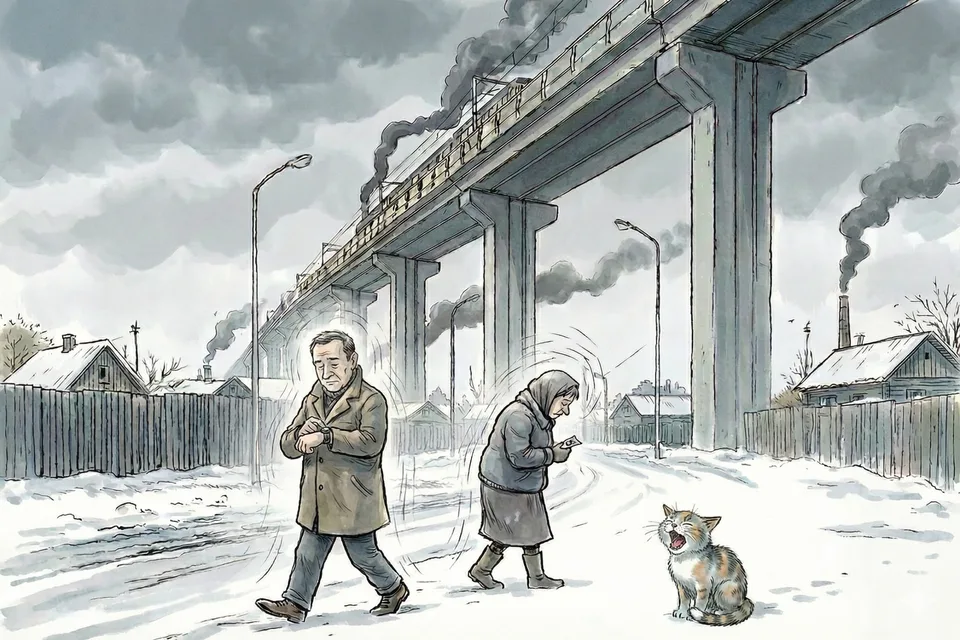
It was December 12, 2025, on the outskirts of Astana, capital of Kazakhstan. The settlement announces itself as a geometry of fences: tall sheets of opaque metal bolted together in straight lines. Under the low, dirty haze of backyard coal furnaces - the primary heat source for a district still waiting to be connected to the natural-gas network - life narrows to maintenance: keeping pipes from freezing, children warm, and the house from bleeding heat into the dark. Even the air seems rationed; people talk about it the way they talk about money.
Almost two years earlier, the government approved a Comprehensive Plan for the Development of the Astana Agglomeration. The budget was set at 1.13 trillion tenge - about $2.5 billion at the time. The plan’s language would have sounded abstract here: “transport connectivity,” “modernizing social infrastructure,” “integrated development.” On the periphery, connectivity meant something else. It meant knowing someone with a working SIM card who could call a taxi when the network faltered, or having a neighbor with jumper cables when a battery died in the cold. The state was building a network visible on maps; on the settlement’s snow-packed verges, the only network that mattered was the one you could reach with your hands.
At six o’clock, the temperature was minus ten degrees Celsius (14°F); by nine, it had dropped to minus fourteen (7°F). In Astana, the thermometer is only the beginning of the story. Wind comes unhindered across a plain so flat it seems engineered. For a warm-blooded creature stranded on asphalt, the arithmetic is blunt: pause long enough, and the cold takes over.
Into the gap between the billion-dollar plan and the frozen ground, a small calico kitten appeared. Her name - at least later - was Feya. For nearly a week, she limped along the roadside, one paw swollen and bloodied, as if the cold had tried to seal the injury shut and failed. She moved in short, determined bursts, stopping to breathe, then continuing. In a system that talks about “flows” and “connectivity,” she worked like tracer dye: released into the current, revealing where movement slowed, stalled, stopped.
I spoke to Alibek, a driver who takes that road every day. He remembered the shape in his headlights, low to the ground, wrong in the way it moved. “I slowed down,” he told me. He checked the clock on his dashboard and made a decision that felt less like a moral choice than a scheduling problem. “Look, the pharmacy closes at nine … I needed my daughter’s medicine. If I stopped, I’d miss it. I just … I couldn’t.”
Across the road, Marat, a security guard at a beauty salon, had a clearer view. He saw the kitten each day for a week. Each day, she dragged herself a little closer to the salon door, as if the building’s light and warmth were a kind of promise. When I asked him why he hadn’t intervened, he rubbed his eyes - not sleepy, just worn. “You see them everywhere here. Too many to count. What am I supposed to do?” he said.
To save a single animal, you have to catch it, find someone with a car, and drive it into the city - an hour-long round trip. Most people here can’t afford to do that on impulse, in the middle of winter, between shifts and children and errands. Most importantly, where would you take it? Who would take care of it?
When Feya finally cried out one night, her voice was high and thin, like an infant’s - an evolutionary design meant to trigger a rescue response. But Astana’s wind has a way of reorganizing instincts. The choice is often framed not as kindness versus cruelty, but as whether you can afford to stop: whether you can stand still long enough to listen, whether you can open a door without letting the cold into your bones. Most people chose warmth and kept moving; empathy can begin to feel like a luxury measured in calories.
Her eyes swollen from conjunctivitis and her body already starved, Feya stumbled into the entryway of the building Marat guarded. On the ground floor, behind the inner door, was the salon. That evening, a woman named Nastya was sitting in a manicure chair. Later, she described herself to me using a phrase in Russian that doesn’t translate cleanly. The closest I can come is: “I’m just a domestic loser” - a preemptive joke with teeth. She rarely drove; she was terrified of scratching her husband’s car and avoided the wheel whenever possible. She held no office and managed no budget. Her authority was domestic, informal, easy to overlook.
“For me, going to the salon is a real escape,” she told me. It was a break from the claustrophobia of housework and the sulfurous smog that hung over the district like a soiled blanket. Inside, the air carried the sharp chemical cleanliness of acetone and the humid warmth of a room full of people in winter clothes. It was a small, deliberate island of comfort.
As the manicurist worked, a faint, high wail drifted through the door - thin at first, almost easy to mistake for something mechanical, then unmistakably alive. The manicurist paused, her file hovering over Nastya’s hand. She exhaled and glanced toward the entrance. “Yeah, she’s been at it all day. Just screaming and screaming. It’s awful, but … nobody’s picked her up.” She reached to pull the door tighter against the draft.
In the corner, the salon’s radio filled the room. A newscaster, cheerful in the way municipal reporting often is, recited the year’s achievements - targets met, budgets spent, projects launched. The words floated in the warm air, clean and disconnected, while outside the street stayed dark and wind-scoured.
“Wait,” Nastya said. She pulled her hand away and stood up.
***
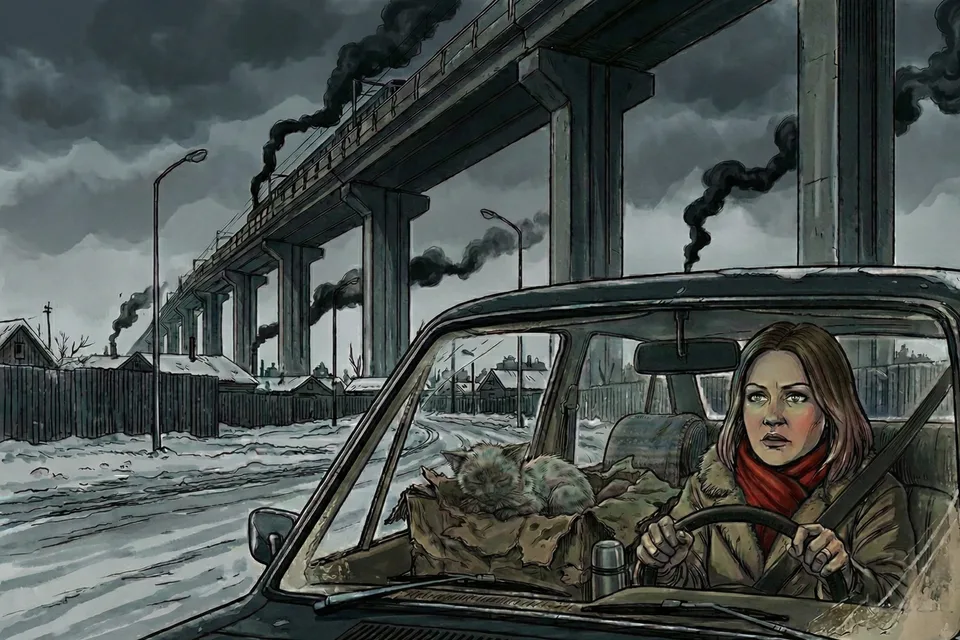
An hour later, Nastya was driving. “I was just trying to survive the eleven-minute drive back to the salon.” That drive - eleven minutes on unlit roads - would become, in her memory, the longest journey of her life. She gripped the wheel of her husband’s aging sedan, her knuckles white against the leather. “I wasn’t driving to a clinic [thirty-eight kilometers (about twenty-four miles) away],” she told me later.
When she first stood up in the salon, she hadn’t taken the kitten. Her apartment was a fortress of constraints: four cats of her own prowling a narrow room, and a husband who viewed pets as livestock. To bring in a sick street animal wasn’t charity; it was a biological breach she could not risk. Nastya, until she decided what to do next, left the kitten in a battered box - a manicurist found it in the salon’s storage room. Nastya promised to pick her up within an hour or two, and cast a digital message in a bottle: she posted a photo on Instagram, tagging a local volunteer group.
She expected silence. Instead, Daria, a young doctor in the city, responded instantly. She bypassed the usual interrogation - Why? - and offered to cover the costs. Daria booked a taxi at a premium rate - six thousand tenge (about twelve dollars), about a third more than the standard fare - enough to ensure a driver would accept the job. And she gave the kitten a name: Feya (Russian for “Fairy”). For Daria, naming was a form of prayer. Years earlier, she had rescued a three-legged dog and named it Joy; against all odds, Joy had found a home and a beloved man. By christening the dying kitten “Fairy,” she was trying to rewrite its future before the vet even saw it.
But the silence returned, this time from the manicurist, who still had the kitten. Nastya called. No answer. In the vacuum, her anxiety began to take inventory of her worth: You took too long. She’s thrown the kitten out. Leave it. Someone else will figure it out.
But Nastya could not leave her. She had grown up in a village deep in the countryside, where sentimentality was a fatal flaw. “I know what the villagers think because I used to be one of them,” she told me. “When I was young, I drowned puppies. It was a chore, like weeding. I didn’t understand the value of a life then.” She paused. “I used to destroy things. Maybe that’s why I must save now.”
“There are hundreds. What can I do?” It was the question people in the settlement asked out loud and answered by moving on. Behavioral economists Sendhil Mullainathan and Eldar Shafir call it “tunneling.” When the mind is besieged by the immediacy of survival - coal prices, debt, the cold - cognitive bandwidth narrows. Inside the tunnel, you solve the problem right in front of you. Outside the tunnel, everything else blurs. Feya lived in that blur. Nastya was fighting a dual battle: one against the physics of ice, the other against the psychology of scarcity.
She skidded to a halt at the salon. The kitten was safe. Nastya hauled the carrier into the car. She needed to intercept the prepaid taxi Daria had paid for - a six-minute drive to the intersection. She loaded the carrier into the passenger seat, and the smell hit her. It was a scent she recognized instantly; years earlier, one of her own cats had been infected, and the odor was etched into her memory. It was the damp, yeasty signature of fungus. Under the streetlights, she peered through the grate. On the kitten’s ears, circular patches of bald, crusty skin stood out. It looked like ringworm - highly contagious.
At the intersection, the taxi waited. As Nastya opened the door, the situation sharpened into a problem. In the back seat, curled against a winter jacket, a child was sleeping. Nastya froze. The money was wired. The goal was clear. But ringworm spores shed easily in warm air. To remain silent was to expose a sleeping boy to an infection that could plague him for months.
Should she tell the truth or just hand over the paid-for box for transport? Nastya leaned in. She told him she suspected ringworm and explained the smell. She begged him to keep the carrier isolated. The driver hesitated. He looked at the shivering woman, then at his son. He exhaled, a plume of steam in the cold car. “You’re lucky I’m not an asshole,” he muttered. “Listen, I’m only taking you because of the extra cash. Put the carrier there - in the corner. Don’t let it touch the kid. Seriously: if he wakes up, I’m stopping the car.”
Nastya closed the door. The taxi pulled away, heading toward Astana.
***
By evening, the evidence of Nastya’s labor had evaporated - this was how most days ended in her house. A pot of soup became silence; a clean floor became footprints; four hours of domestic maintenance compressed into a husband’s complaint that lunch was cold. He lifted the lid, took a spoonful, and said it without looking up, as if temperature were an accusation. Her internal accountant could account for every minute - the scrubbed tiles, the folded laundry, the coal dust swept from the entryway - but the house itself offered no receipt. By six o’clock, her achievement looked exactly like the absence of disaster - which is to say, it looked like nothing.
That day, she had called the utility company about the gas line, waited on hold for forty minutes, and was told to call back tomorrow. She did what she had learned to do with a kind of grim professionalism: to keep a fragile system from failing. The philosopher Hannah Arendt had a name for this kind of effort. She called it “labor,” distinguishing it from “work,” which leaves something durable behind. Labor was consumed the moment it was produced; it had to be done again the next day. It was the infrastructure of ordinary life, and it was almost designed to be overlooked.
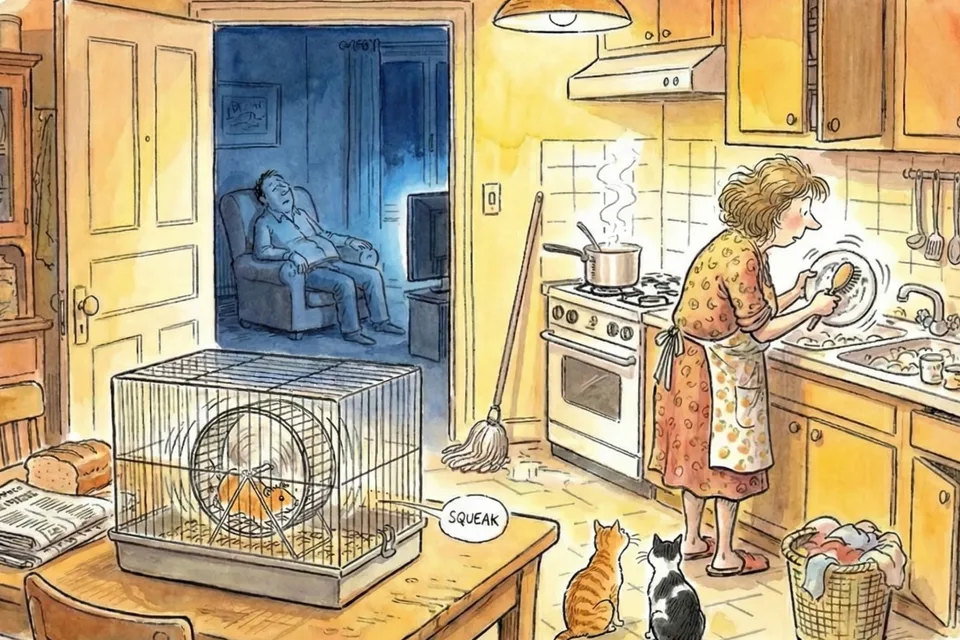
For twenty-three years - since she married at twenty-two - Nastya lived inside that loop. She ran a household like an unpaid administrator, patching problems before they became visible, managing needs that would never appear on a balance sheet. In a culture that respected what could be sold and counted, she learned to describe herself as a “domestic loser” - a joke with teeth, delivered preemptively, before anyone else could deliver it for her.
There had been one person, though, who refused to look past her. He was a parish priest - an ethnic Pole named Father Janek - who arrived in Kazakhstan in the late nineties. He’s dead now. There are no streets named after him. His grave is modest. He did not behave like a man collecting followers; he behaved like a man collecting persons.
Eight years earlier, Nastya sat across from Father Janek in the parish office. “The room smelled of old paper, radiator heat, and strong, very strong, cheap black tea,” she recalled. “He always drank tea and never seemed to wash his mug.” The radiator clicked and sighed behind her; his chipped cup sat directly on the paperwork, leaving a faint brown ring on the corner of a form. The desk between them was buried under genealogy records, birth certificates, and a Polish grammar workbook with a cracked spine. He had the tired, practical focus of someone who had spent his life negotiating small bureaucratic humiliations on other people’s behalf.
She had come for the Karta Polaka - the Pole’s Card - a document Poland issues to people in Kazakhstan and other post-Soviet countries who can prove Polish ancestry. It wasn’t a guarantee of escape, but it opened a legal route out - an escape hatch, if you squinted. “I wanted my son to have this opportunity,” Nastya said. “My husband said it was all nonsense - for dreamers. And I didn’t want to start a fight I wouldn’t be able to end it anyway.”
She didn’t know how to approach it, but someone suggested going to a Catholic parish. “It was my first time in church,” she said. The forms on the desk were daunting and thick. Nastya pushed the stack away. “I can’t do this,” she said. “I don’t understand any of this. I’m wasting your time.”
Father Janek pulled the papers back toward him. He didn’t offer a prayer. He pulled out a chair. For three hours that afternoon, he sat with her. Translated entries in birth certificates written in faded script. He rehearsed Polish phrases with her, correcting her vowels with the patient exactness of a man who had nowhere else to be. He treated the application - a bureaucratic tangle that most priests would dismiss as secular business - as an altar service. When Nastya finally stood to leave, the papers were in order. Father Janek walked her to the door and handed her the folder. “You think God only sits in the church?” He tapped the folder. “He deals with this paperwork, too.”
Over the next twenty months, Father Janek kept making time for her family - after Mass, between errands, on afternoons he might otherwise have spent resting. He tutored Nastya’s son in Polish, drilled him on the history questions, corrected his mistakes, and sent him back to try again. Twenty months later, the card - and, with it, a route to Poland - was in her son’s pocket. Father Janek never talked about abstract saving souls. He talked about archives and missing stamps and the proper way to form a sentence. He made her feel - briefly, decisively - counted. This was the part of care that didn’t evaporate. It travels.
When Nastya stood in the beauty salon years later and decided to interrupt her own small escape from everyday chores to pick up a broken street kitten, it wasn’t a random glitch of conscience. It was a practiced motion - the same muscle she had used to secure her son’s future when she had no future of her own. The ability to care for the well-being of others, honed by years of domestic labor. Someone had once looked at her - a woman whose days disappeared into other people’s comfort - and treated her time as valuable. Nastya looked at Feya - a creature the system had rendered disposable - and treated her life the same way.
As the taxi carrying Feya dissolved toward the skyline, Nastya stayed where she was, breathing into her scarf. She pulled out a cigarette - a habit Father Janek had tried, gently and unsuccessfully, to help her quit - and lit it with shaking hands. The wind made it hard. She cupped the flame, inhaled, and watched the dark close back over the road. Then she turned and walked back to her husband’s car. It was time to go home.
***
Late that night, Nastya made it home, washed her hands, and fed her four cats in the narrow kitchen, as if the routine could rebalance the day. Her husband had fallen asleep with the television on. Outside, the settlement lay dark and wind-scoured. Her phone kept blinking on the table. The rescue chat was alive with short updates - drivers, addresses, receipts. While she rinsed a bowl and wiped the counter, a message came through: the taxi had reached the clinic.
The driver’s son was still asleep in the back seat, a winter jacket pulled up to his chin. The carrier sat by the passenger door, angled away from the child. Mariam was waiting at the entrance - young, bundled, her breath visible in the clinic’s porch light. She was a student with no money to donate but time to give. She had seen Nastya’s post, messaged to ask what she could do, and since Daria had covered the costs, Mariam offered to handle the handoff. She took the box from the driver and carried it inside.
At the reception desk, the vet on duty wrote up the intake: thirteen thousand tenge - about twenty-six dollars - for the exam and initial procedures. In the exam room, he turned off the overhead lights and switched on a Wood’s lamp. Under the ultraviolet beam, patches of fur glowed fluorescent green. “Microsporum,” the doctor said; the fluorescence was suggestive of ringworm.
He ran his fingers along the kitten’s ribcage. She was a lattice of bone. He offered food. “The skin looks bad, obviously. But look at this,” he pointed to the food. “Dying animals don’t usually eat like that,” he said, almost to himself. Then he listened to her lungs. They sounded clear.
He concluded the screaming had been pain - tactile, constant, inescapable. Not a catastrophe you could hear in her chest, but pain that seemed to set the body on fire from the outside in. He injected ketoprofen. Within minutes, the kitten slackened. The frantic edge fell out of her muscles, as if someone had finally turned down the volume. For the first time in what looked like weeks, she slept.
The diagnosis also set a limit. The clinic could examine her, medicate her, stabilize her - but it wasn’t set up to keep a contagious stray. Ringworm meant quarantine, and quarantine meant somewhere else. In the chat, Nastya posted one name and an address: Katerina S. Mariam called another taxi. She rode across the city with the carrier on her knees and a hand resting on the grate, as if contact could substitute for warmth. The destination was Katerina S.’s apartment.
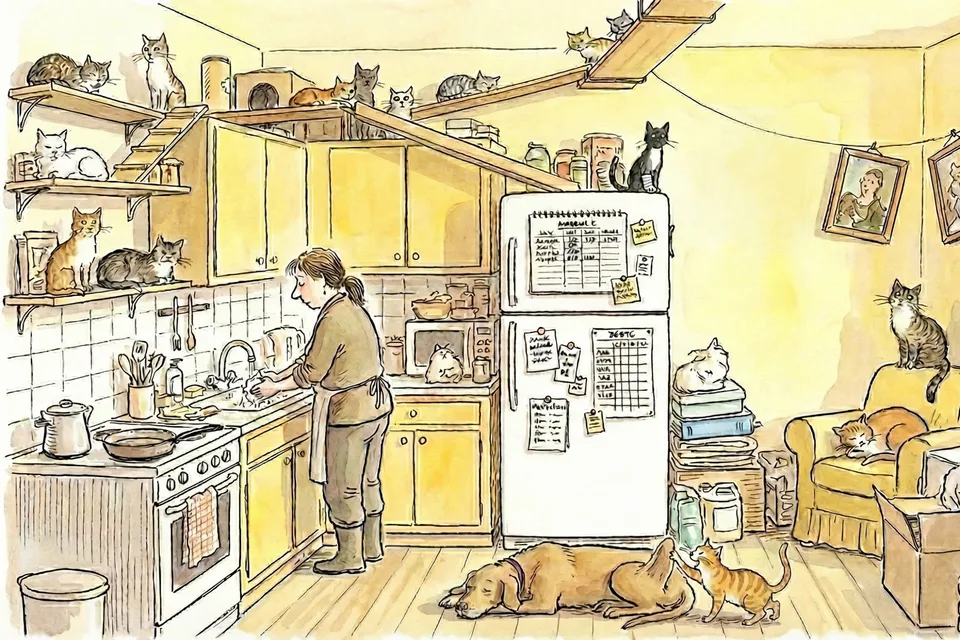
Katerina S.’s home was not a shelter; it was a field hospital squeezed into about forty square meters (roughly 430 square feet). The walls were lined with shelves and plush bedding; ramps and catwalks let traffic flow overhead. On the floor, avoiding a tail required constant vigilance. Only the kitchen had a semblance of human decoration - a couple of paintings hanging on a string. Even these were unstable; as soon as the furry patients recovered enough strength to play, they knocked them down.
Sponsors - people who wanted to help but could not take in an animal - paid a modest contribution, around twenty thousand tenge (about forty dollars) a month per cat, to cover food, litter, and the constant labor of quarantine and care. The hallway smelled faintly of disinfectant. A stack of folded pads leaned against the bathroom door. On the refrigerator, a magnetic notepad held a grid of medication times, names, and debts, written in tight, practical handwriting. Her dog, Greta, moved through the rooms with the bored competence of an animal used to too many temporary bodies. When the carrier arrived, Feya became the thirty-fourth cat in the ecosystem. Katerina S. set the bathroom up as a quarantine zone and slid the carrier onto fresh pads. She washed her hands, then washed them again.
She had learned the darker physics of the last mile of aid. People brought animals with good intentions and promises of money, then faded away. Eleven cats had arrived with promises of sponsorship that dissolved after the first month - messages left on read, numbers disconnected. Sometimes someone took a cat home and then brought it back weeks later, overwhelmed. Katerina S. took them back, too. The system held because she did.
“I don’t always blame people,” she told me once, when we talked about the debts she absorbed. “People promise to pay, and then … things happen. Kids get sick, cars break down. They just vanish.” One of the people who didn’t vanish was Liliya, a donor in Germany. For almost two years, she quietly paid for the upkeep of three cats - animals she’d never seen, whose names she knew only from chat. If one of the furry creatures in her care found a home, she’d take in the next one. When Fairy showed up, she promised to cover everything that was needed.
For the next seven days, Feya lived in sterile safety. In the chat, updates arrived like vital signs: she ate; she slept; she tolerated the medicine; she was weak but quiet. At 10:30 p.m. on December 19, Katerina S. sat down to feed her patient. The kitten was too tired to lift her head; she took food from a syringe, a few drops at a time. And then, for the last time - and perhaps the first in her life - she made the sound rescuers wait for: a faint, rhythmic vibration in her chest.
Purr.
Katerina S. set the syringe down and watched her for a long moment, not moving. The kitten settled onto her designated pillow and closed her eyes. On December 20, at 9:15 a.m., Katerina S. came back to check on her. Feya lay exactly where she had fallen asleep. But the stillness was absolute.
The message hit the rescue chat in the morning light. Nastya read it in her kitchen, phone in hand, her cats weaving around her ankles for breakfast. She sat down at the table. Without thinking, she reached for a cigarette, cracked the window, and lit it. Then she typed, the old self-mockery turning sharp: “I’m a fucking domestic loser. Why am I always too late?”
In that thread, six women ended up mourning her: Nastya, who had found her; Daria, the doctor who paid the first bill; Mariam, the student who carried her; Katerina S., who fed her; Liliya, the donor in Germany; and Dr. Katerina K., the group’s consulting veterinarian, who, by cruel irony, had been out of town and could only follow the week through a screen.
Dr. Katerina K. returned to Astana that morning. By noon, she was at Katerina S.’s apartment - too late to examine a living patient, just in time to lift a small body from a box. Standing over the treatment notes, she understood the reflex that follows a loss: the hunt for villains. Why no ultrasound? Why treat the skin and miss what was happening inside? Was this negligence?
“It doesn’t work like that,” she said. “Cats hide pain. It’s instinct - in the wild, showing weakness makes you prey. By the time you can see it, it’s often too late.” Cats are predators, but small enough to be prey. Evolution rewarded the animal that could keep moving, keep eating, keep seeming fine - right up until it couldn’t. The deception isn’t a choice; it’s survival. She believed the kitten had been dying for weeks before Nastya ever saw her under the salon’s lights. The warmth, the food, the medicine - none of it saved her. It only gave her something the street hadn’t: a quiet place to stop, without screaming.
“The ringworm was loud,” Dr. Katerina K. said. “The rest was quiet.”
***
In the evening of December 20, only a few hours after Feya’s body was carried out of Katerina S.’s bathroom, the rescue chat didn’t go quiet. The icon kept blinking. New names appeared. A fresh photo drifted into the thread, followed by a short message: two more kittens, somewhere on the outskirts, and no one to take them. Then came another line - dry and practical, the way grief so often is online: “But now at least I know who to transfer those twenty thousand tenge to. Otherwise you never know if you’ll get scammed. I’m sorry about Feya.”
On the way home from the “cat hospital,” my taxi driver told me the city’s elevated light-rail line - the LRT - had finally started running. For now it was only test trips, without passengers: one of the visible results of the $2.5-billion promise that had sounded so fluent in abstractions out in the settlement. He called it a ‘monorail’. “A big thing for Astana,” he said.
The pylons were a story you could point to. The other kind rode with us - in a car still haunted by the sour, yeasty smell of ringworm, once driven by a terrified woman who decided to break the cycle of indifference; and in the last-mile care that kept materializing where the city’s systems did not. In the architecture of memory, that car and that house are load-bearing walls; both deserve the same visibility and respect as the ‘monorail’.
There are treetops, and then there is mycelium - the network under the soil that links trees through a hard season. In Astana, the “Feya” chat did the same work. It moved small things that mattered: money for a taxi, a spare bathroom for quarantine, a bottle of a bottle of chlorine bleach, an hour of someone’s time - each gesture ordinary by itself, decisive together.
For seven days, Feya made that network visible. She was a social tracer dye, released into the current, revealing what usually stays out of sight - including the bright light in the souls of the “domestic losers,” buried under housework and coal-black air. For a week, the screen was packed with logistics - addresses, receipts, medication schedules. And then, as always, the thread began to creep upward, buried under the next address, the next receipt, the next emergency. The mycelium kept spreading.
Nastya sat at her kitchen table; a cigarette burned down in the ashtray by the cracked window. That morning she didn’t type her old insult into the chat: shame and self-reproach can’t pay a bill or help anyone. A new photo was on the screen, and the thread was waiting - not for sympathy, but for a decision. She dialed Katerina S. “Katya,” she said. “Two more. The group is ready to help with the money.” Katerina S.’s voice was tired, but steady. “Bring them,” she said. “The bowls are waiting.”
* Some names have been changed at the request of the people involved.
** This story is dedicated to those who do good deeds without fanfare. They deserve to be remembered.